Corporate Data Hub

Operate your own data hub to break down silos and facilitate data circulation within your organizations.

What is a Corporate Data Hub?

A Corporate Data Hub aims at fostering data circulation between various entities of the same corporation, such as business units, subsidiaries or departments.

A Corporate Data Hub is a powerful solution facilitating internal data products discovery and exchange in compliance with policies and regulations, even more when sub-entities of the corporation have different legal structures, heterogeneous data infrastructures, reside in different geographies or are subject to different data regulations.


Data is a cornerstone of large corporations’ performance

Large organizations produce and own increasing volumes of data, which are becoming more and more vital to improve performance on multiple strategic dimensions such as:

  • Market knowledge
  • Operational improvements
  • AI agents and AI models performance
  • Regulatory requirements, in particular regarding sustainability with CSRD and ESPR regulations

Therefore, it is critical that pertinent data owned by any subsidiaries, business units or sub-organizations can be shared internally, i.e that they are made available, discoverable and accessible to other entities of the corporation under the conditions set by the data owner. These conditions include complying with confidentiality, security, traceability and regulatory requirements.

Internal data exchange challenges in large corporations

Large corporations are complex organizations, with multiple entities often operating with a certain degree of independence and spread across different locations around the world. As such, they face several challenges when it comes to efficiently exchanging data:

Lack of trust

  • Subsidiaries sometime partially competing on a given market
  • Cautiousness to share “strategic data” even between departments
  • Absence of flexible data contracting and licensing capabilities control, making compliance more complex with regulations and policies applying to sub-organizations.

Data and IT systems fragmentation

  • Corporations comprise autonomous entities in various geographies, with different legal structures, different data regulation requirements, and different data governance processes
  • Multiple heterogeneous data platforms and IT infrastructures spread across corporations lead to data silos and poor interoperability

Poor data discoverability

  • Insufficient knowledge of data products, or data assets, available in other entities
  • Lack of semantic tools to describe data products with pertinent sectorial ontologies

No scalability for data exchanges

  • Failure of traditional data sharing means, like emails, shared folders or EDI when it comes to large scale, governed and compliant data exchanges
  • Data platforms and data fabrics, focused on data processing and internal data governance, lack capabilities to govern and control data exchanges at scale with heterogeneous third party infrastructures.

These challenges result in higher data management costs, missed market opportunities, sub-optimal operations, and higher regulatory risks for corporations.

Corporate Data Hub –The answer to internal data exchange challenge

A Corporate Data Hub allows entities within large organizations to break down data silos, and extracts maximum value from the data spread across the organizations by enabling:

  • Data providers to publish and promote a selection of their data products internally through federated catalogs conceived for high discoverability
  • Data acquirers to search, quickly find and access data products
  • Data providers and acquirers to rely on standards on Trusted Data Transaction, by agreeing on fully traceable contractual terms and licenses of usage
  • Interoperability between heterogeneous and fragmented data systems, by providing technical, syntactic, semantic and governance interoperability capabilities
  • The orchestrator, in charge of operating the Corporate Data Hub, to set rules and policies, govern the ecosystem, and ensure compliance of data exchanges with data and sectoral regulations

Additionally, a Corporate Data Hub is a convenient first step to extend to external data exchanges, either with Industry Data Space or Data Marketplace models.

Interview of Group TF1 Chief Data & Adtech Officer on how TF1 accelerates internal data exchange with Dawex technology 


The TF1 Group has chosen Dawex Corporate Data Hub solution to create the Hub TF1, and accelerates the deployment of data use cases to enrich its internal service offering thanks to more premium data. The TF1's data community will be able to discover, structure and exchange data & services securely, with trust, while retaining control over visibility, access rights and conditions of use of the data products.


François-Xavier Pierrel, Group Chief Data & Adtech Officer at the Group TF1, explains in this interview the importance of Data Exchange in the Group's digital acceleration strategy, and why the group made the choice of Dawex Technology. 


Corporate Data Hub use cases and benefits

By setting up a Corporate Data Hub strategy, large organizations can unlock many use cases, and benefit from many positive impacts:

  • Costs reduction: Mutualisation of data sourcing activities, rationalization of data scientist activities.
  • Operational improvements: Sharing data between plants and headquarters in different regions to drive process optimizations, connecting AI agents, feeding AI models with qualitative and traceable data, driving production costs down, improving supply chain operations, and spreading best practices across the organization.
  • Market efficiency: Sharing market and customer data between corporate organizations, with trust and in full compliance with regulations, to foster product innovation and boost commercial efficiency.
  • Compliance risks reduction: Managing governed and controlled data transactions to comply with the European Data Governance Act, Data Act and AI Act, as well as meeting sectoral regulatory requirements.
  • Achieving CSR goals: Consolidating CO2 footprint from plants, logistics and supplier activities, monitoring CSR initiatives and results.
  • Industrializing reporting: Streamlining reporting from multiple sub-organizations
  • Digital transformation: fostering a data product approach throughout the organizational entities, improving data assets description and discoverability, paving the way to external data exchanges in Industry Data Space or Data Marketplace modes.

Interested in building a Corporate Data Hub?

Data exchange is more and more in the agenda of organizations. To explore how to develop a thorough data exchange strategy and implement a Data Exchange Platform, get guidance from Dawex experts.

Corporate Data Hub solution powered by Dawex –A rich set of functionalities

With Dawex Data Exchange Solution, organizations implementing a Corporate Data Hub benefit from the most advanced solution to accelerate internal data sharing and distribution.

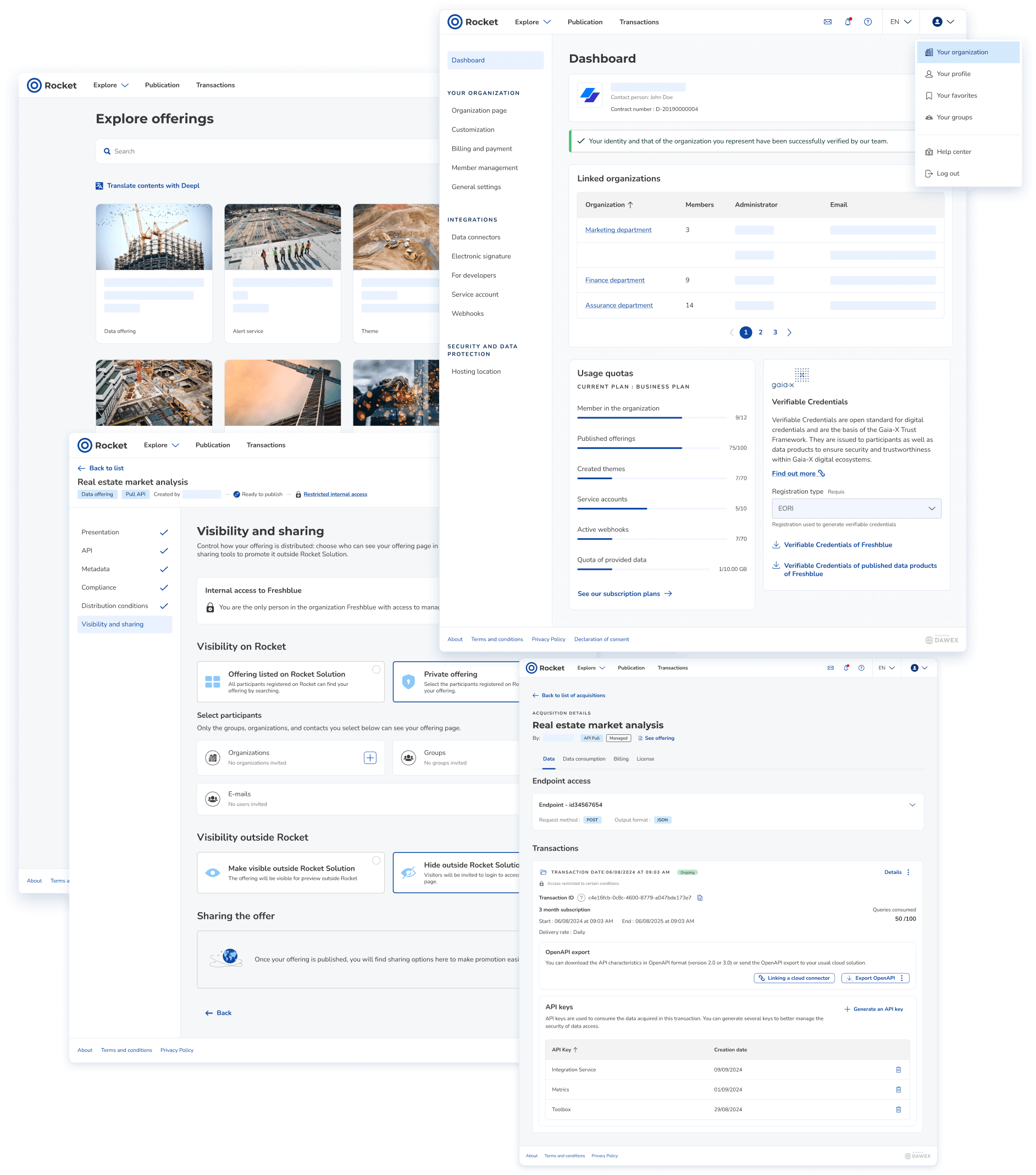
Relying on the advanced Dawex Data Exchange technology, a Corporate Data Hub solution gains native capabilities to respond to business and technical challenges such as security and privacy requirements, compliance with data regulations, trust in data transactions, flexibility of the business modeling and the performance and interoperability of an open architecture.

  • Set the data ecosystem’s governance and business modeling
  • Industrialize data product publication
  • Facilitate data discoverability for data acquirers
  • Control and monitor data product distribution & consumption
  • Support secure, trusted & compliant data transactions
Meet your business challenges with Data Exchange

By orchestrating its own Data Exchange solution, an organization takes leadership by positioning itself at the core of the ecosystem. More broadly, implementing a data exchange strategy fosters productivity and efficiency, increases company valuation, tackles decarbonation objectives, reduces risks, and helps generate new sources of revenue.

Schedule an exploratory call with a Data Exchange expert