An interoperable Data Exchange technology
Delivering a high-level of interoperability to address organizations complex challenges
The interoperability challenge in data exchange
Each participant of a data space or a data marketplace comes with its own data governance, its choices of solutions and infrastructures, and specific use-cases that require various data management and transfer strategies.
This results in a fragmented ecosystem of organizations, data infrastructures, data platforms, data catalogs, AI agents and applications that do not talk natively to each other and do not trust each other a priori.
The interoperability challenge is to create the conditions making it possible to industrialize and scale-up data exchange between these multiple silos, and to support a growing number of use-cases.
The 4 layers of interoperability
To solve this challenge, 4 layers of interoperability must be addressed by data exchange solutions:
-
Organizational interoperability: Establish trust between participants. In order to agree to exchange data with another organization, a participant must be sure the ID and the claims of the other participant are trustful. This requires the support of heterogenous, often decentralized IDs & claims management systems, coupled with robust onboarding and vetting processes, enforcing the rulebook from the data space governance authority. It also means sharing a common governance framework and interoperable governance policies compliant with international norms and standards
-
Legal interoperability: Agree on common legal terms & conditions associated with a data transaction. Beyond trusting each other’s identities, data providers and data acquirers must agree on a common legal package to trust their data exchanges are managed within a common and consistent legal framework. This includes legally binding T&C, contracts and data licences, pricing and distribution conditions, which are ideally translated in a machine readable format.
- Semantic interoperability: Facilitate data product description, research, and create the conditions for machine to machine data exchanges. When exchanging data from an organization to another, the first thing is to make sure the data product is described through standardized metadata, at the semantic level, so that data providers and acquirers have no doubt about the nature of the data exchanged. Additionally, some use cases require that the data itself follows a standardized semantic framework, so it can be automatically ingested by an application on the data acquirer side, without human intervention.
-
Technical interoperability: Manage the connection between participants' IT systems. Data and metadata associated with a data product and a use-case lie in many different systems such as data infrastructures, AI agents, business applications, data platforms or data catalogs. In order to industrialize and automate data exchanges as much as possible, it is essential to provide secure and standardized technical means to share data and metadata that constitute data products in a data space or data marketplace catalog. This includes providing managed connectors to various platforms and applications and supporting multiple technical transfers such as file transfer, API push, API pull or decentralized connectors.
Interoperability within and between data spaces is at the core of Dawex vision and has been a compass for product development since Dawex inception. As a result the Dawex Data Exchange Solution, as the most advanced solution on the market, integrates these 4 interoperability conditions in a user-friendly experience that hides the underlying complexity to the participant organizations. Data Spaces and Data Marketplaces powered by Dawex technology deliver a high level of interoperability and empower their participants to develop and scale-up many different use cases.
Organizational interoperability
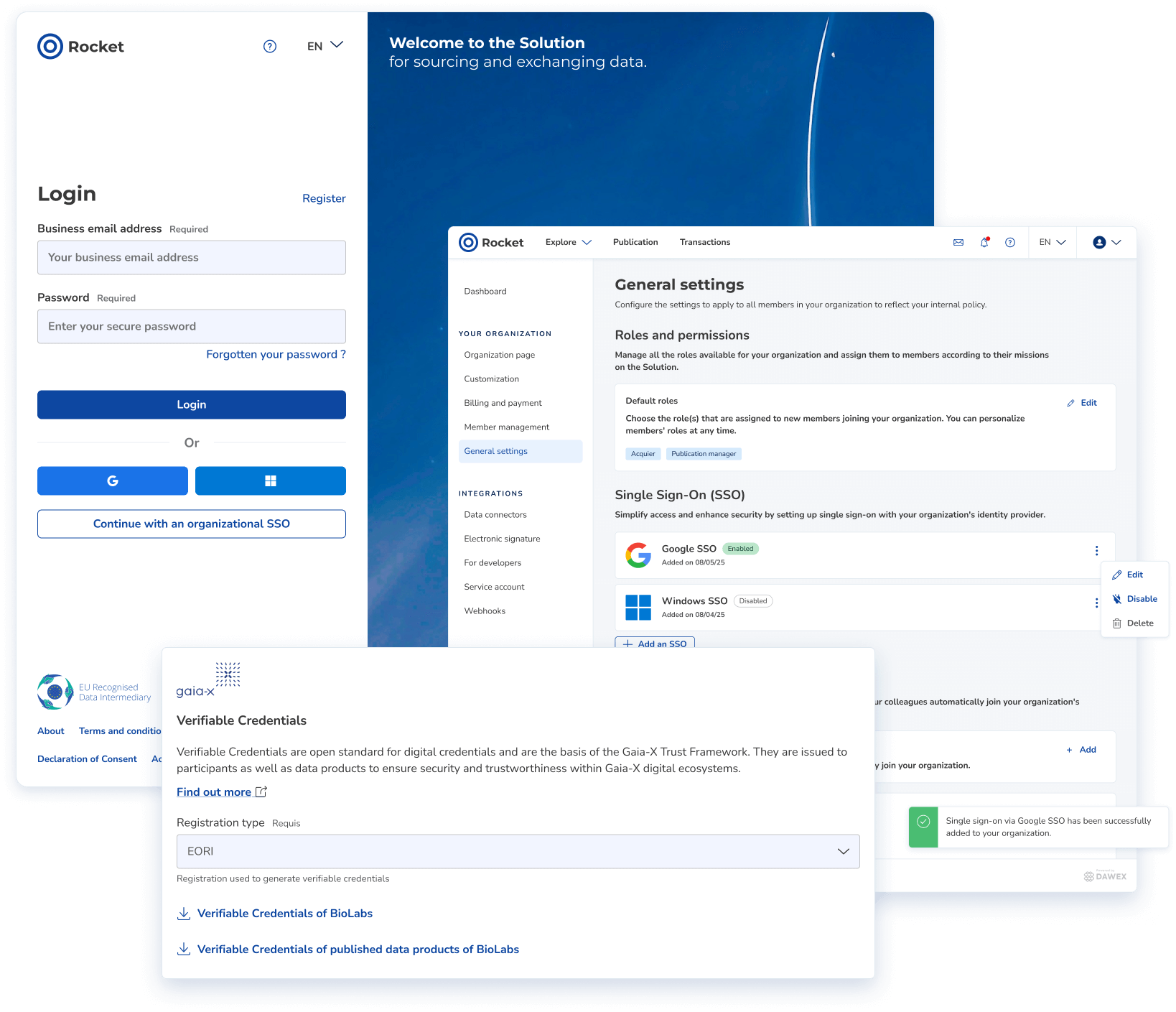
The Dawex Data Exchange Solution supports a wide range of trust building, ID management mechanisms and participant’s lifecycle management, allowing to exchange data even in low trust environments.
-
Implementation of international trust frameworks and norms such as Gaia-X, Trusted Data Transactions, EUDI, associated with powerful governance tools
-
Compliance with international data regulations : RGPD, Data Act, Data Governance Act, DISP status, and international or cross border data regulation
-
ID management: support of SSO, federated Identities, decentralized Identities
-
Configurable onboarding and vetting processes to apply specific business policies and facilitate onboarding for different type of companies, from SMEs to large corporations
Legal interoperability
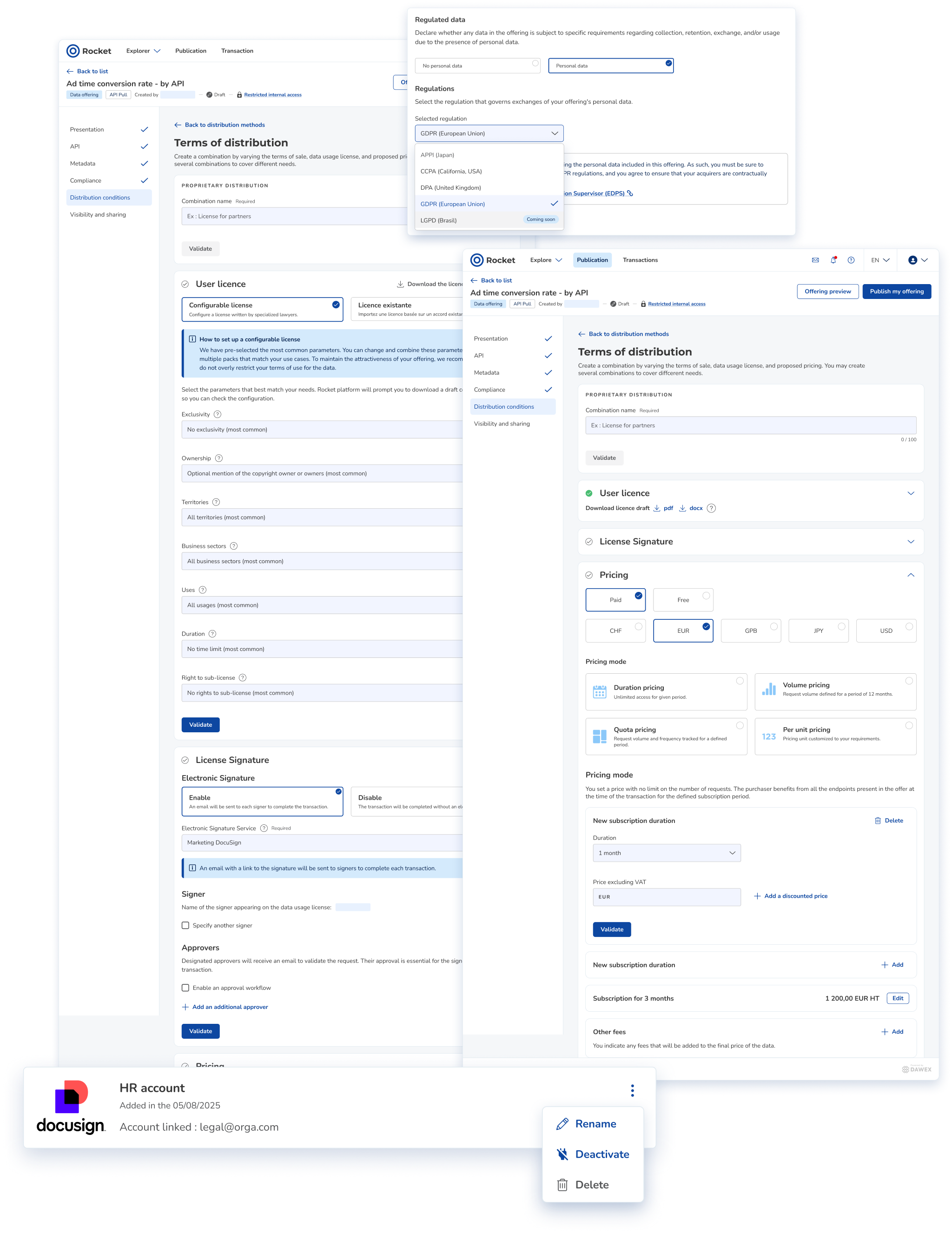
The Dawex Data Exchange Solution delivers standardized capabilities to describe and validate data transactions, including contractual terms and access / usage rights. With these capabilities, data providers and acquirers have a common ground of understanding and can operate their data exchanges within clear, common terms.
-
Configurable data contracts and licences
-
Distribution, pricing and payment conditions
-
Compliance with the harmonised European standard Trusted Data Transactions
-
Management of access and usage rights
-
ODRL (Open Digital Rights Language)
-
Traceability of the data transaction
Semantic interoperability
The Dawex Data Exchange Solution supports semantic interoperability at several levels, and is constantly enriched by new technologies stemming from R&D:
-
Data product semantics: configurable taxonomies to standardize data product description.
-
Data semantics: data model standards can be published in the data marketplace “semantic hub”, allowing participants to share data that can be automatically processed by business applications.
-
Legal semantics: data transaction contracts and licences can be configured by participants based on standard templates, and can be transformed in ODRL for automated policy enforcement.
Technical interoperability
To reach true interoperability in a Data Space or Data Marketplace, a data exchange solution must provide simple and secure means to connect to applications, data or metadata assets of any participant organization, and then technically orchestrate data exchange between fragmented systems.
The Dawex Data Exchange Solution delivers a full set of technical interoperability mechanisms, allowing participants to keep control and apply their data governance rules to the data exchanges:
-
Connectors to most data platforms and data storage infrastructures, ready- to- use and simple to implement (including but not limited to Databricks, Snowflake, GCP, AWS, S3, blob storage…). New connectors are frequently released
-
Native integration and compatibility with data transfer protocols used in all industries (REST, Data Space Protocol) or industry-specific (such as OPC-UA and Asset Administration Shell in the manufacturing industry)
-
Service APIs to automate integration with organizations’ applications and processes. They allow the automation of processes such as data product publication, metadata import from data catalogs, or data transactions
-
MCP protocol integration to connect AI agents and models
-
Support of managed file transfer, API push, API pull mechanisms
-
Support of decentralized Data Transfer Agents (DTA), such as DSP connectors
Dive into compelling resources on Data Exchange
Leverage performant and open Data Exchange solutions
Dawex Data Exchange technology is highly performant, resilient, interoperable and based on open standards. By implementing the Gaia-X Trust Framework & standards, the Data Exchange Solution of Dawex facilitates the interconnection with other data applications and data spaces.